This article is for general educational purposes and is not a substitute for medical evaluation. Endometriosis requires diagnosis and treatment planning from a licensed OB/GYN.
A teenager with cramps is told she just suffers from bad periods. Ten years later and still cramping, still bleeding through pads in an hour, she heard the same thing from three different doctors. That’s not a rare story. Seems to be the more average one. The American College of Obstetricians and Gynecologists estimates that endometriosis affects about 1 in 10 women in their reproductive years, and the typical wait between symptoms starting and an actual diagnosis is four to eleven years.
What’s actually happening?
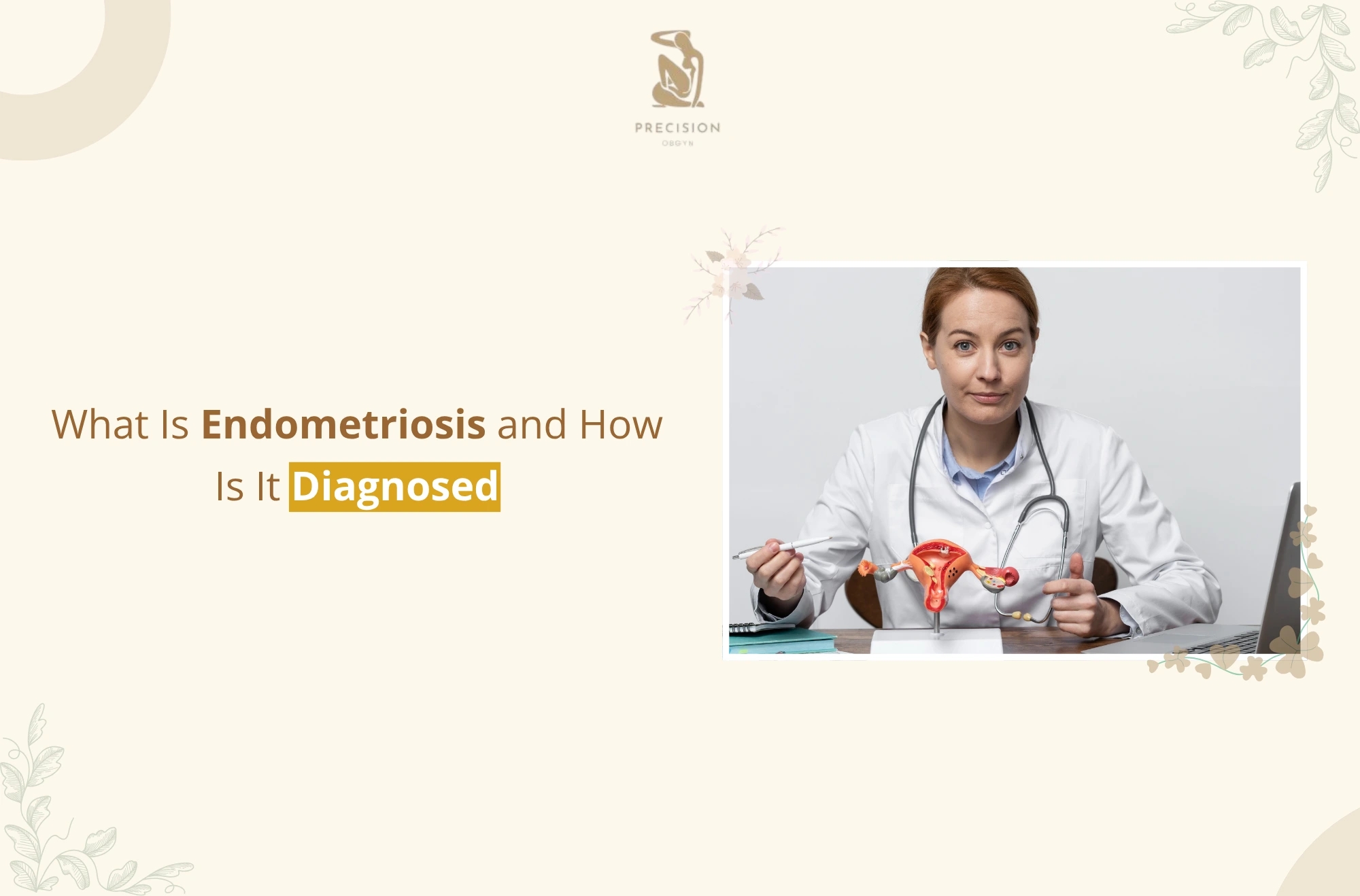
Endometriosis is tissue that acts like the uterus lining growing where it should not be growing (usually on or surrounding ovaries, fallopian tubes, or covering the pelvic area). It reacts to hormonal signals like the mother uterine lining every month. Thickens. Breaks down. Bleeds. Except it has nowhere to go. A normal period leaves the body. This doesn’t.
Inflammation occurs from trapped blood and tissue. All that inflammation, over time, builds scar tissue; adhesions, bands that can almost graft the organs together that were never really meant to touch one another. It is not the tissue that produces most of the pain. It arises from what the body does in attempting to deal with it.
The symptoms don’t line up neatly.
Painful periods get the most attention but the full picture is messier than that:
- Ibuprofen hardly touches period pain
- Pain during sex
- Pain with bowel movements or urination, especially around your period
- Pelvic pain that shows up outside the days you’re bleeding
- Heavy bleeding, or bleeding between cycles
- Fatigue, bloating, nausea tied to menstruation
- Trouble getting pregnant
Here’s the part that throws people off: how bad the symptoms are doesn’t track with how much tissue is actually there. Some women have widespread endometriosis and barely notice. Others have a small patch and can’t get out of bed. There’s no reliable correlation, which is exactly why relying on symptoms alone to guess severity doesn’t work.
Why this takes so long to catch?
A few things stack on top of each other. The symptoms overlap with IBS, ovarian cysts, pelvic inflammatory disease, and plain old bad cramps, so endometriosis usually isn’t anyone’s first guess. Painful periods have also been treated as normal for so long that women get told to just push through it, sometimes by people who should know better.
And there’s a structural reason too. For decades, a definitive diagnosis meant surgery. Understandably, that’s not where most doctors or patients want to start, so a lot of women went through a slow process of ruling everything else out first.
How diagnosis actually works now.
It starts with a real conversation. When does the pain happen, how bad, how long has this been going on, does endometriosis run in the family. That last one matters more than people realize, since there’s a genetic component.
From there, imaging usually comes next. A transvaginal ultrasound can catch endometriomas, ovarian cysts tied to endometriosis, and rule out some other causes of pelvic pain. It won’t catch everything though, superficial lesions especially tend to slip past ultrasound. MRI picks up more detail in some cases, particularly deeper disease, but it has its own blind spots too.
Laparoscopy is still the only way to see the tissue directly and confirm it under a microscope. For years, this was treated as a required first step before treatment could even begin, which is a big part of why diagnosis dragged on so long for so many women. That’s changed. In February 2026, ACOG released its first formal guidance backing a presumptive diagnosis, meaning history, exam, and imaging can be enough to start treatment without surgery first. Laparoscopy still gets used when symptoms are severe, imaging doesn’t give clear answers, or the treatment decision genuinely hinges on a confirmed diagnosis. It’s no longer the mandatory gate it used to be.
Treatment depends on what you’re actually trying to do.
There’s no single right answer here, it depends on the goal.
- Hormonal treatment, birth control pills, progestin therapy, GnRH agonists, can quiet the signals driving tissue growth and pain
- NSAIDs manage pain without touching the underlying tissue
- Surgery to remove endometrial and scar tissue can reduce pain and sometimes improve fertility
- For women trying to conceive, the plan usually looks different, since some hormonal treatments used for pain control also prevent pregnancy
There’s no cure. But most symptoms can be managed well with the right combination, and the plan usually gets revisited as things change, not set once and left alone.
When to actually go in?
You shouldn’t have to live with pain so severe that it interferes with work, school or your day-to-day living. If you are dealing with severe period pain, pain during sex, pelvic pain that just will not stay in its lane and is radiating everywhere else, problems getting pregnant — all of this stuff should be looped into the OB/GYN immediately instead of waiting to see if it resolves on its own.
If period pain has never felt normal, it’s worth finding out why.
Precision OBGYN, led by Dr. P.S. Gordon, MD, a board-certified obstetrician and gynecologist, evaluates and treats endometriosis and other gynecologic conditions in Miami and Aventura, FL.
Every treatment plan is built around the patient in front of him.
Call 305 424-8622.
You can also visit precisionobgynfl.com to schedule your appointment.